
Slight increase in new job vacancies compared to a year ago
- News
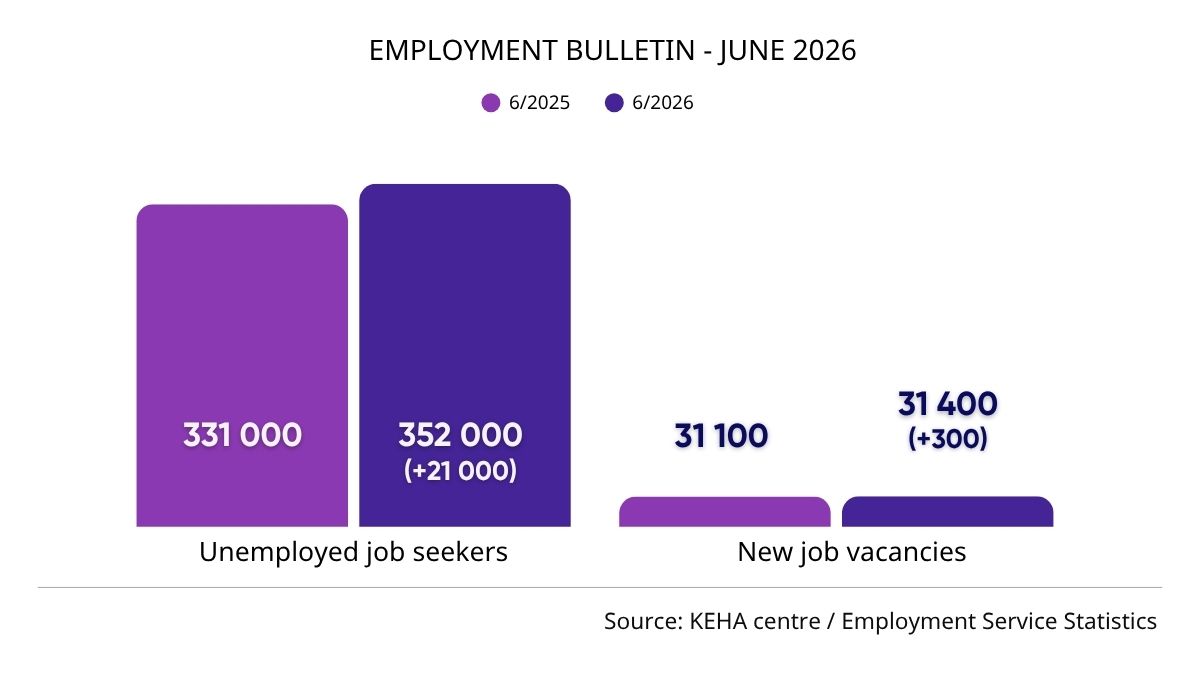
The KEHA Centre’s Job Market Finland platform (Työmarkkinatori) received 31 400 new job vacancies during June, representing an increase of 300 vacancies compared to a year earlier. At the end of the month, there were 352,000 unemployed jobseekers, while 416,200 people were included in the broad measure of unemployment. The figures are based on the Employment Bulletin published by the Development and Administrative Services Centre (KEHA Centre).

At the end of June, the number of unemployed jobseekers was 6 per cent higher than a year earlier. The number of people included in the broad measure of unemployment also increased by 6 per cent compared with the previous year.
“The number of unemployed jobseekers includes unemployed clients of municipal employment services as well as those temporarily laid off full-time. In June, there were 15,500 persons laid off full-time, which was 1,900 fewer than a year earlier and 500 more than in May this year”, says Suvi Timonen, Researcher at the KEHA Centre.
Unemployment increased in all age groups
Compared with a year earlier, unemployment increased in all age groups. There were 48,300 unemployed jobseekers under the age of 25, which was 6,200 more than a year earlier. Of youth unemployment spells, 46.5 per cent ended before reaching three months during January–June. This share increased by one percentage point compared to a year earlier. Of all unemployed jobseekers, 84,400 were aged over 55, which was 3,300 more than a year earlier. During January–June, 43.8 per cent of unemployment spells among people over the age of 55 ended within three months. This share was 1.1 percentage points higher than in the corresponding period last year.
Slight increase in the number of new job vacancies
During June, 31,400 new job vacancies were reported to Job Market Finland, which was 1 per cent more than during the corresponding period a year earlier. An increase was observed only in the occupational group of craft and related trades workers. Altogether, 55,500 vacancies were open during June, which was 8,100 fewer than a year earlier.
Use of activation services increased; activation rate remained almost unchanged
At the end of June, 64,200 persons were participating in services included in the activation rate, which was 4 per cent higher than a year earlier. These services include, among others, pay subsidies, labour market training, rehabilitative work activities, and independent study supported by unemployment benefits.
“At the end of June, the activation rate was 15.4 per cent, which was 0.3 percentage points lower than a year earlier. Participation in activation services declined particularly in rehabilitative work activities, where the number of participants decreased by 24 per cent compared with a year earlier. By contrast, the number of participants in labour market training increased by 45 per cent compared with the situation a year ago,” notes Suvi Timonen, Researcher at the KEHA Centre.
At the end of June, the number of persons employed through employment services, meaning those claiming pay subsidies or receiving start-up grants, totalled 12,100, which was 4 per cent lower than a year earlier. Long-standing open periods in the Employment Service Statistics database have been corrected. These corrections significantly reduced the numbers of persons employed through employment services, persons participating in services, and the activation rate. The revisions have been applied to all monthly data for 2025 and 2026. As a result, the 2026 figures presented in the Employment Bulletin are comparable with those for the corresponding period of the previous year.
Key differences between the Employment Service Statistics and the Labour Force Survey
The source of the Employment Service Statistics of the KEHA Centre is the customer register of municipal employment services, while the Labour Force Survey of Statistics Finland is a sample survey.
In the Employment Service Statistics of the KEHA Centre, anyone who is not employed or acting as an entrepreneur is classified as unemployed. Persons fully laid off but not full-time students are also categorised as unemployed in the Employment Service Statistics.
The Labour Force Survey of Statistics Finland has a stricter definition of unemployed: a person is unemployed if they have actively sought employment during the preceding four weeks and are available for work within two weeks. The Labour Force Survey of Statistics Finland produces official unemployment figures that are internationally comparable.
Further information
Suvi Timonen, Researcher, KEHA Centre, tel. +358 29 502 0255, tyonvalitystilasto@keha-keskus.fi, Evaluation and Knowledge Management Unit
More information
- Employment Bulletin by the KEHA Centre (tyollisyyskatsaus.fi)
- Statistical database of the Employment Service Statistics (tyonvalitystilasto.fi)
- Employment Service Statistics data in the StatFin database (statfin.stat.fi)
- Labour Force Survey by Statistics Finland (stat.fi/en/statistics)
- More information on the differences between the statistics (media.stat.fi)