
Language lecturer
"If you like people, learning and developing new things and can work independently, the lecturer's profession suits you. You are never complete as a teacher, so you must continuously develop your competence."
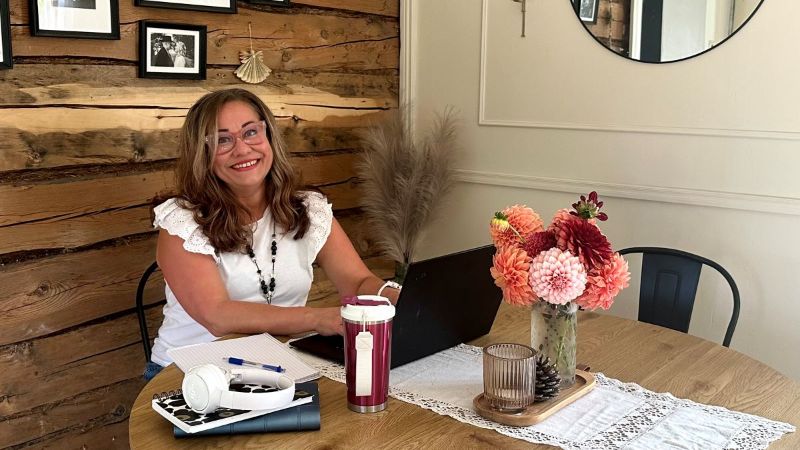
- Monika Engel
- Language lecturer at Satakunta University of Applied Sciences.
- Graduated Master of Arts from the University of Turku.
- 25 years of work experience in the field.
Briefly explain what you do for a living.
I work as a language lecturer at a university of applied sciences and teach Swedish and German. Besides teaching, my work involves guiding and evaluating students, planning instruction and developing learning materials and online courses. I also work in various expert and development groups and take on project-based assignments from time to time.
In other words, the work of a lecturer is much more than just teaching. It's above all expert work.
How have you ended up in the profession of your choice?
I spent the first ten years of my childhood in Germany, where we spoke German at home. Finland and the Finnish language only came into my life when my family moved to Finland. So I have grown up between two languages and two cultures. I believe that my background has played a major role in making languages and teaching feel like a natural choice for me.
In the 1990s, as a mother of two small children, I started studying German language and culture at the University of Turku. From the start, it was clear to me that I wanted to become a language teacher. I started my career in upper secondary school and later moved to a university of applied sciences. Here, I get to work with students of all ages – from young people to adults with long careers.
Describe your typical working day or week.
My typical day might start with contact teaching on campus and continue with a meeting and a student guidance session. In the afternoon, I do grading and plan my lessons, and in the evening, I may still teach remotely from home.
The workdays can be long and fragmented, so good time management is important.
What kind of work environment or working hours do you have?
I work both on campus and remotely. I'm spending more and more time working independently at the computer, and my work also includes remote teaching in the evening.
Teachers at universities of applied sciences follow the annual working time, so working hours and workload vary at different stages of the academic year. For example, an assessment period or planning a new course can sometimes take a lot of time.
What kind of competence or qualities are required in the profession?
The work of a language lecturer requires pedagogical and interaction skills as well as expertise in one's field. As a language teacher, I also need to know the working life and professional language of different fields.
You must be self-directed and ready to keep developing your own competence. I often wonder if there's something I could do differently to help students learn better – or even get them excited about learning.
You need good time management skills, as you must be able to plan and prioritise your work. Digital competence is also required.
What is the best thing about your profession?
The best part is the people and interaction. It's rewarding to see students' skills and confidence grow, and sometimes they might get excited about something that seemed uninteresting at first.
I also like the fact that I get to constantly learn new things and develop my own work.
What are the downsides of the profession or what seems challenging?
The hectic schedule and fragmented work can feel overwhelming. As a language teacher, you also have to constantly justify the importance of studying languages. There has been a long-standing discussion in Finland about the decline in language diversity, and you can see it as a German teacher.
Learning a language takes time, practice and effort. You can't learn everything with a few clicks. The teacher must be able to pique the student's interest and help them stay motivated.
What would you tell a person considering the profession of a language lecturer?
Be prepared for the fact that your work will be constantly changing. It's actually a good thing that I didn't know in the 1990s how much teaching would change. It might have felt scary.
If you like people, learning and developing new things and can work independently, the lecturer's profession suits you. You are never complete as a teacher, so you must continuously develop your competence.
How do you see the future of your profession?
The work of a language teacher has changed drastically. When I started teaching in the early 2000s, the blackboard and overhead projector were everyday tools. Now we have online courses, digital learning environments and AI.
The change is rapid, and teachers must constantly learn new tools and assess what really supports learning. Technology changes the tools, but at the same time, it forces us to ask what is really important in a teacher's work. I believe that interaction between people will remain at the heart of teaching in the future as well.